


Dear reader,
A few years ago, the song “Persephone” by John Mark McMillan caught my attention. Every so often, I become hyper-fixated on a piece of music. It typically annoys my wife, and she is justified in her annoyance, because, for a week or more, it’s the only thing I’ll play, whether it’s in the car driving around, in the kitchen cooking, or one last listen before bed from the Bluetooth speaker on our dresser. I just can’t get enough of it. AirPods saved my marriage in this regard.
But I’m pretty sure that with this song, my hyper-fixation lasted longer than a week. For a month or more, the melody and lyrics of this track completely enchanted my imagination and gave me hope in an uncertain time of life. Take a listen.
When I discovered this song, I was in a season of uprooting, a “liminal-space,” if you will, a transition from what was to what will be. But the horizon of my future was blurry at best.
Sometimes songs can hit at just the right time and in just the right way. This was one of those times for me.
Faith was graduating from her master’s program in two short months. The pressure was on. We had agreed that, upon her graduation, we would chase my prospects. The only problem was that I didn’t have any substantial ones. I was lost.
I was managing a coffee shop, driving a school bus, pursuing a seminary degree, and traveling the ministry circuit like John Wesley. The only difference was that Wesley preached and carried a bible. I led worship and carried an acoustic guitar.
In the song, McMillan uses the ancient Greek myth of Hades and Persephone as a foil to explore some deeper themes in the human experience. I’m not much of a Hellénophile, so I had to rely on my trusty friend, Google, to understand the allusion. But as soon as I began to map my own story alongside it, things started clicking.
Persephone and the lord of the dead
Do we all go down for a season
As the story goes, one day Persephone—who was the beloved daughter of Demeter (the goddess of nature, agriculture, and harvest)—was frolicking in a beautiful field picking flowers and enjoying her youthful innocence. She came across a patch of narcissus flowers (also known as spring daffodils) that were carefully crafted to entice her. When she reached down to pick them, the earth opened up beneath her, and she was abducted by Hades, the god of the underworld.
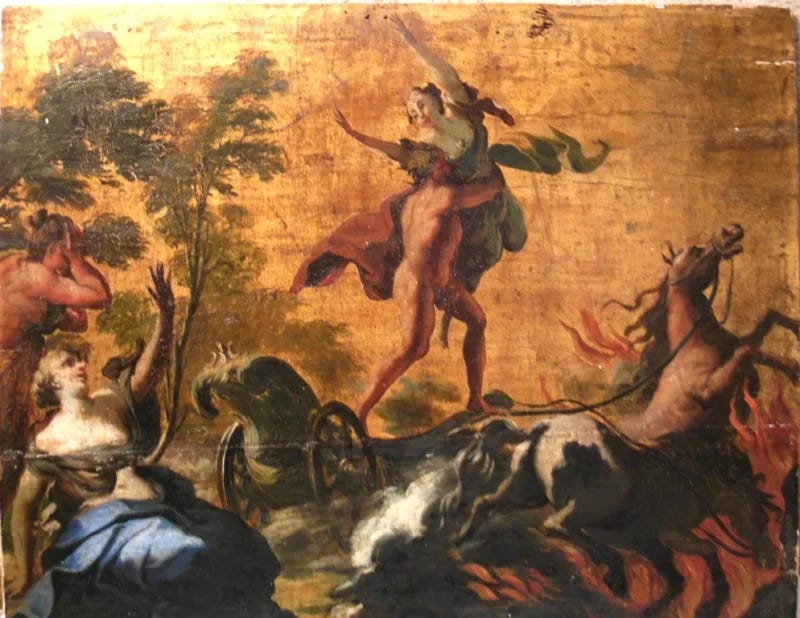
Demeter’s grief over Persephone’s abduction drove her into relentless mourning and a desperate search, during which she refused food, abandoned her post at Olympus, and caused the earth to wither. Eventually, a compromise was struck—Persephone would split her time between Hades and Demeter, giving rise to the seasonal cycle of growth and decay.1
This Greek myth explains the changing of the seasons, but perhaps more importantly, it reflects the human experience of transition—that often brings forth grief, transformation, and renewal… if we’ll allow it.
On this interpretation, the underworld is not a place that we despise, nor is it a place we try to avoid.
No.
The underworld is an inevitable destination in life. As sure as the sky is blue, Persephone will be splitting her time between the underworld and the earth.
Like Persephone, we all go down for a season.
My experience of the underworld is that I’m not aware that I’ve been there until I’ve left it behind for the next thing.
Have you ever found yourself in the middle of a transition in life? A big move? A job change? A new relationship? A loss? A gain? If attended to carefully, these transitions can be spaces of great transformation, especially if we are attentive to the dynamics of the in-between, when we are moving from one thing to the next.
The creatures that we see
The images we collect
You can’t bring them into the spring sun
McMillan continues, writing from the perspective of Persephone in the dark and gloomy underworld. Whatever it was she saw or acquired there, cannot go with her to the land of the living. These lines point toward that peculiar human tendency toward acquisition and disordered attachments. In short, clinging.
Persephone must leave everything behind. She cannot take anything with her.
She must not cling to what was there.
In seasons of great uncertainty and change, humans are inclined “to cling” to things. We cling to all sorts of things—money, relationships, success, youthfulness, comfort, etc. But we must not cling. These hoarding tendencies keep us from being open to receiving what’s next.
Clinging amounts to chaining ourselves to the underworld, never again to see the spring sun.
Ronald Rolheiser riffs on this in his book Holy Longing, highlighting the story in John’s Gospel where Mary attempts to hold on to the resurrected Jesus. The problem with this, says Rolheiser, is not Mary’s love or affection for Jesus. It is that she is clinging to a former version of Him, holding on to who He was and not allowing Him to be who He is now and who He is ultimately going to become: the resurrected Christ and the ascended Lord. It is for this reason that Jesus utters the famous words, “Do not cling to me, Mary” (John 20:17).2
I look back to when I first discovered this song, and realize now that I was clinging to my life as I had come to know it. I was quite comfortable with what I had and where I was, but deep in my guts, I knew that it was time to move on. I needed to loosen my grip so that I could move to the next thing. It was this clinging tendency that kept the horizon of my future so blurry. But as soon as I loosened my grip, things became clearer.
The lyrical genius of the song lies in the chorus.
I don’t want to dance anymore with dark nostalgia
I don’t want to hold hands with the dreams of a dead man
Nostalgia is a beautiful gift. For example, when you are in the middle of a rocky season with a spouse or other relationship, it can help to practice nostalgia together, recalling a time when you were deeply in love or when things were smooth sailing. Such a practice can sustain and nourish the relationship when things are less than ideal.
There are other times in life where an image, or a meal, or even a smell can set off a flurry of activity in your brain’s memory center, evoking feelings of great joy and satisfaction. This experience is good nostalgia at work. Remembering the joy of playing outside with friends during summer break, riding bikes, and having ice cream. Conjuring these memories and their corresponding emotions is nostalgia’s superpower.
But nostalgia can turn devilish on a dime. Like many things in life, it has the potential to become an idol. It transforms into something harmful when we allow it to dominate our thoughts and feelings. Nostalgia becomes dark and idolatrous as soon as we hand over our souls to it.
Nostalgia becomes detrimental when we view the past through rose-tinted glasses, ignoring the challenges we faced or warping the truth for a lie. It can also lead us astray when we become entranced by its myth-making abilities, believing that “nothing compares to the past,” which hinders our ability to appreciate the present and move confidently into the future. We start chanting things like “Make ___________ great again,” and our emotions follow suit.
McMillan’s anthem chorus reminds me that to move out of this dark and detrimental dance with nostalgia, I must make a declarative statement and choose to let go.
We may cling and grasp and cleave, but if we ever want to receive the blessing of a new season, we must let go of the dreams and live in reality, so as to experience a new future.
I dig into the folds of my mind
Scavenging the cracks sometimes for answers
But hope is not, as I have come to find,
Something that you understand, but a trust
Hope is not something that you understand, but a trust.
This is a mystery. Some Christian traditions call it the Paschal Mystery, where death and letting go become the doorway to something greater than we can ever imagine.
On a smaller scale, transition in life can be a kind of paschal mystery as well. I wish I had this concept back then; I might have done things a bit differently.
In my season of transition, those many years ago, I remember looking everywhere for answers, searching for understanding. Every little thing was a sign. Every conversation circled back to me and my problems. Finding understanding was an all-consuming activity. In a sense, it was self-centric. I was so hell-bent on trying to find the answer to my own problems that I missed what was right in front of me. Had I known that what was in front of me was an opportunity to enter into the paschal mystery, I might have managed this life transition a little differently.
Our obsession with certainty and understanding is actually slavery, chaining us to the underworld, dancing with nostalgia for eternity, keeping us from seeing the spring sun ever again.
This is all very clear to me now, partially because it is all hindsight, and you know what they say about that.
I’ve had sufficient time to process and reflect on that transition many years ago and make sense of it in light of new learnings and experiences. But transitions in life are manifold, and as soon as we think we’ve made sense of one, we find ourselves in the middle of another.
McMillan’s bridge ties it all together for me.
When I was young I thought I would become
Someone different than who I find myself to be
But in my weakness I've come to believe
Who I am is greater than the man of who I once dreamed
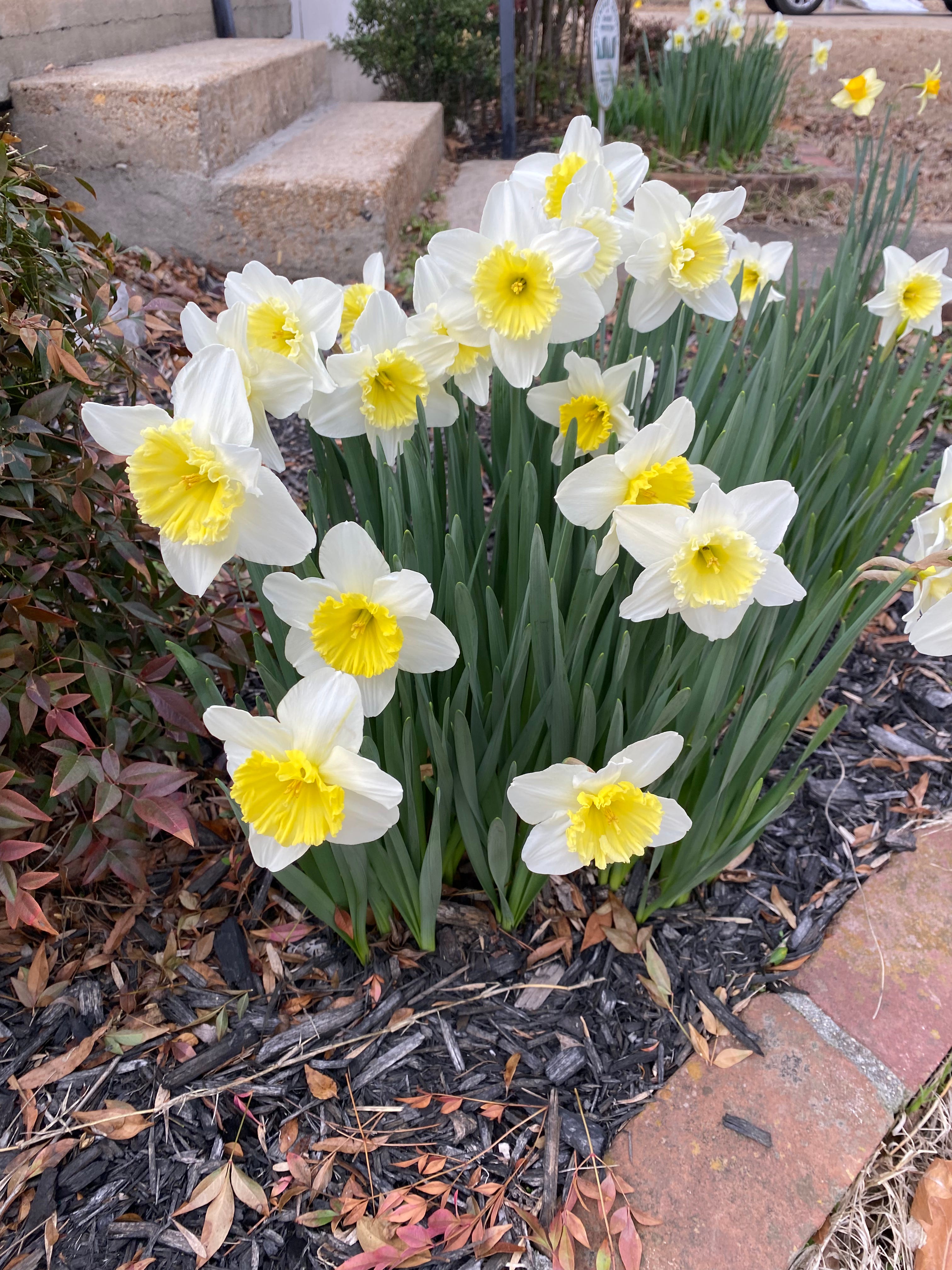
Today, I find myself on the precipice of a new transition in life. I’m staring at daffodils while the world is opening up beneath me.
Not to be dramatic or anything, but what I am referring to is my 30th birthday.
I remember a time when the sound of 30 seemed ancient. Time is weird, and so is aging.
But I can honestly say that I am not afraid or worried about what’s ahead. I’m excited and know that the death of the 20s is not the death of me, but only the beginning of something beyond what I currently know.
I relate to the lyrics above so much in that I truly could have never imagined my life the way it is today. Any dream or vision I had for my life as a young man is gone by the wayside. Things are so much different from what I had envisaged for myself and my future. The key is in learning to accept this reality and find the gift in what is rather than what could have been.
I love that McMillan invokes weakness as strength. This is gospel, and this is good.
The fact that I do not know what lies ahead in this new decade places me in a position of vulnerability and weakness. But I am learning that in my weakness and vulnerability, I am keeping good company with Christ, who, “though he was rich, yet for your sake he became poor, so that you through his poverty might become rich” (2 Corinthians 8:9).
Or as it says elsewhere, “For the foolishness of God is wiser than human wisdom, and the weakness of God is stronger than human strength” (1 Corinthians 1:25).
In navigating life’s transitions, we often find ourselves in a liminal space, much like Persephone in the underworld, where clinging to the past can hinder our growth and transformation. Nostalgia, while a beautiful gift, can become a burden if we allow it to dominate our thoughts and emotions. Embracing the paschal mystery of letting go opens us to new possibilities and deeper understanding. As I enter my 30s, I recognize that the end of one season is merely the beginning of another. By accepting the reality of change and finding strength in vulnerability, we can move forward with hope, trusting that what lies ahead is greater than what we leave behind.
I caught a glimpse of some spring daffodils outside my little cottage home in Arkansas. They are beautifully weak creations, and so are we. And that is how it should be.
Yannis Samatas. "The Myth of Hades and Persephone." greekmyths-greekmythology.com, 10 Nov. 2010. Updated 28 May. 2025, https://www.greekmyths-greekmythology.com/myth-of-hades-and-persephone/.
Rolheiser, Ronald. The Holy Longing: The Search for a Christian Spirituality. New York: Image, 2014.
Lot of wisdom in this post. Thanks for sharing.
If we fail to learn from the past we most assuredly will repeat it - Santayana, Churchill, ME :)
The “pascal mystery” is likely the most painful experience for a human to endure through.