


Dear Reader,
This series explores the search for a “sacred home,” asking what it means to be a Christian and how spiritual and religious identities shape our understanding of ourselves and others.
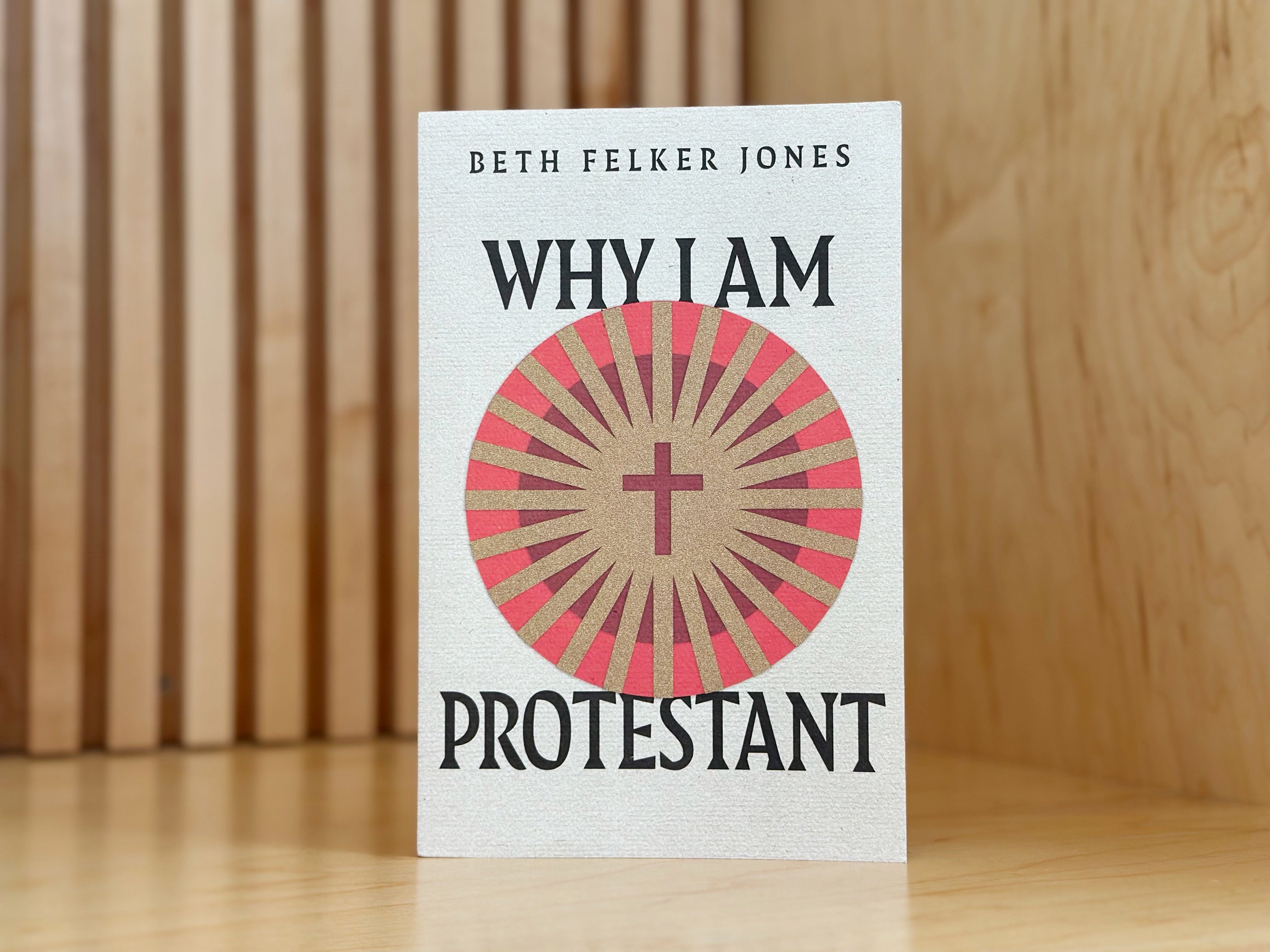
Today, I am excited to share with you a book I read recently called Why I Am Protestant by Beth Felker Jones, which has helped me think more about my own sacred home. This book is one of three books in the Ecumenical Dialogue Series from IVP Academic. The goal of the series is to cultivate greater dialogue between the three major branches of Christianity.
The book will officially be out on September 30th, but you can pre-order a copy now. Or, if you’d like to read a little sampling of the book, you can download this free excerpt.
What does this have to do with finding a sacred home? Well, as it turns out, Christianity is quite a large house, with many rooms and places to explore. In his book, Mere Christianity, C.S. Lewis employs this metaphor of a large mansion to conceptualize the vastness of the Christian tradition. Lewis says that the great hall inside the mansion represents historic orthodox Christianity unified around the early church creeds, and that the doors and rooms attached to that great hall represent the major branches of the Christian tradition.
I like this metaphor. And it’s helped me understand my place in that great house.
I grew up in a church tradition that began in the late 18th and early 19th centuries during the Second Great Awakening in America. It was called the Restoration Movement and was led by two Presbyterian ministers, Alexander Campbell and Barton W. Stone. The goal of the movement was to bring unity to the Church by patterning itself after the early church, a worthy goal and its greatest strength, which ultimately became its greatest weakness.
I do not despise the tradition in which I was raised, and in many ways still hold on to the good fruit born out of that particular tradition while leaving behind the chaff on the threshing floor. After all, it was this church that introduced me to Jesus, taught me the gospel, baptized me into Christ, and played a pivotal role in my education and spiritual formation well into my adulthood. But as I have learned more about Christianity in all of its vastness, I have come to realize that the Church of my youth was not the only “one true church,” as I was often taught. To borrow Lewis’s metaphor, the church of my youth was more akin to a shoe box within a drawer, inside a dresser, inside a room attached to that great hall within the big house of Christianity. And it has done me a lot of good to step out of that room for a bit and explore other parts of the house—not necessarily to switch rooms or abandon the shoe box altogether, but to find a greater appreciation of the whole, and to understand my place within it.
Beth Felker Jones’s book has helped me do just that: Find a greater appreciation in the whole of Christianity, but particularly Protestant Christianity, a specific wing of Lewis’s great Christian house. The book has helped me understand why I am Protestant and why I remain so, and has helped me articulate what the particular goods of Protestantism are for the Church today, and there are many.
Now, before I go any further, let me say this. I have dear friends who were raised Protestant but are now Catholic. I also have dear friends who were raised Catholic, but are now Protestant. I even have friends who have either become Eastern Orthodox or are actively considering making that leap. I also have friends who have left the big house of Christianity altogether and are either renting different properties down the road or have bought a new house in some other neighborhood (I am milking this metaphor for all its worth).
I say all this to say, I consider my Catholic and Eastern Orthodox friends as brothers and sisters in Christ Jesus. I am not writing from a posture of triumphalism, as if Protestantism has all the answers or is somehow the only faithful expression of Christianity. Rather, I write as someone grateful for my own tradition while also deeply aware that the Body of Christ is larger, more diverse, and more mysterious than any one stream of it. My intent here is not to convince anyone to stay or to leave, but to share why I remain Protestant, what I see as its particular treasures, and how I believe it contributes to the flourishing of the Church universal.
With that in mind, and Beth Felker Jones’s book in hand, here are three reasons that I am Protestant:
Three Reasons I Am Protestant
1. I Was Born Into Protestantism
If you find yourself resisting this reason, then you might be swimming more in the cultural waters of neo-liberalism than you think. In a neo-liberal framework (the predominant worldview of the West) the model human is the entrepreneur of the self. Individual identity is relatively independent of context and relationships. Individuals have the power and right to govern themselves. Individuals should pursue the satisfaction of their own desires, including happiness and well-being. (Check out this post for more insight into the neo-liberal framework and how it functions in a therapy setting. Very interesting stuff). Therefore, to say that we are Protestant because we are born into it goes against our neo-liberal inclinations that we are autonomous, self-made individualists. We are certainly not self-made.
But, just because we are born into something doesn’t necessarily mean that it is not good or true, and that the grace of God cannot be at work there too.
I love what Beth Felker Jones writes in the first chapter of her book,
In many Protestant circles, “I-grew-up-in-a-Christian-home” tends to be voiced as an apology, with sheepishness, as though the work of God were less than when it happens through childhood and home and being raised in the church.
Grace, though, works in domesticity and in community. Grace works in parents who nudge their kids out of bed every Sunday, despite the “I don’t wanna go” and the “Church is boring.” It works in mothers who teach the Lord’s Prayer by bedsides and fathers who model giving and integrity. It works in local churches through Sunday school classes and youth groups and sermons and Bible studies. God does not eschew the domestic or the local. God does not disdain the quiet or the small.
God came to us to grow-up-in-a-Jewish-home, and that same God is happy to work in gentle and slow stories in other homes where God is honored. God also works in explosive and public ways. I love the dramatic conversion stories some of my friends can tell. But I am not a Christian because of my quiet story, and those friends aren’t Christians because they met God in fireworks. We are Christians because of God. We are Christians because of who God is and what God is doing in our lives, in the church, and in all creation.
Beth has helped me see the grace of God at work in my own faith story. She has helped me see that just because I was born into a particular Christian stream does not mean that God was not at work in it. She has helped me see that even though my church tradition was far from perfect and had many flaws, grace is still always working in the Church, and I thank God for that.
2. Protestant Ecclesiology Makes Space for Brokenness
*Ecclesiology is a fancy way of saying “theology of the church.”
I must confess: More often than not, it is easier for me to see the brokenness of the church rather than its beauty. I am not necessarily proud of this statement, but it is true nonetheless. And I say this as a pastor at a church. Don’t tell my boss.
I do not blame my friends who have left the great house of Christianity altogether. I do not blame those who were raised in the church and have left it behind, never to return. I do not blame those who “love Jesus, but hate religion.” I find myself somewhat agreeing with their oft-touted reason: “the church just doesn’t seem to have any redeemable quality to it.”
Indeed, church experiences have been the source of a significant amount of pain for many folks. The church is rampant with human sin and abuse. The church has often traded its witness for influence in the world. It has prostituted itself to political power, to wealth, and to status. The church of history has initiated and funded religious wars. It has segregated the body of Christ and compromised its witness through racism, patriotism, misogyny, and the list could go on.
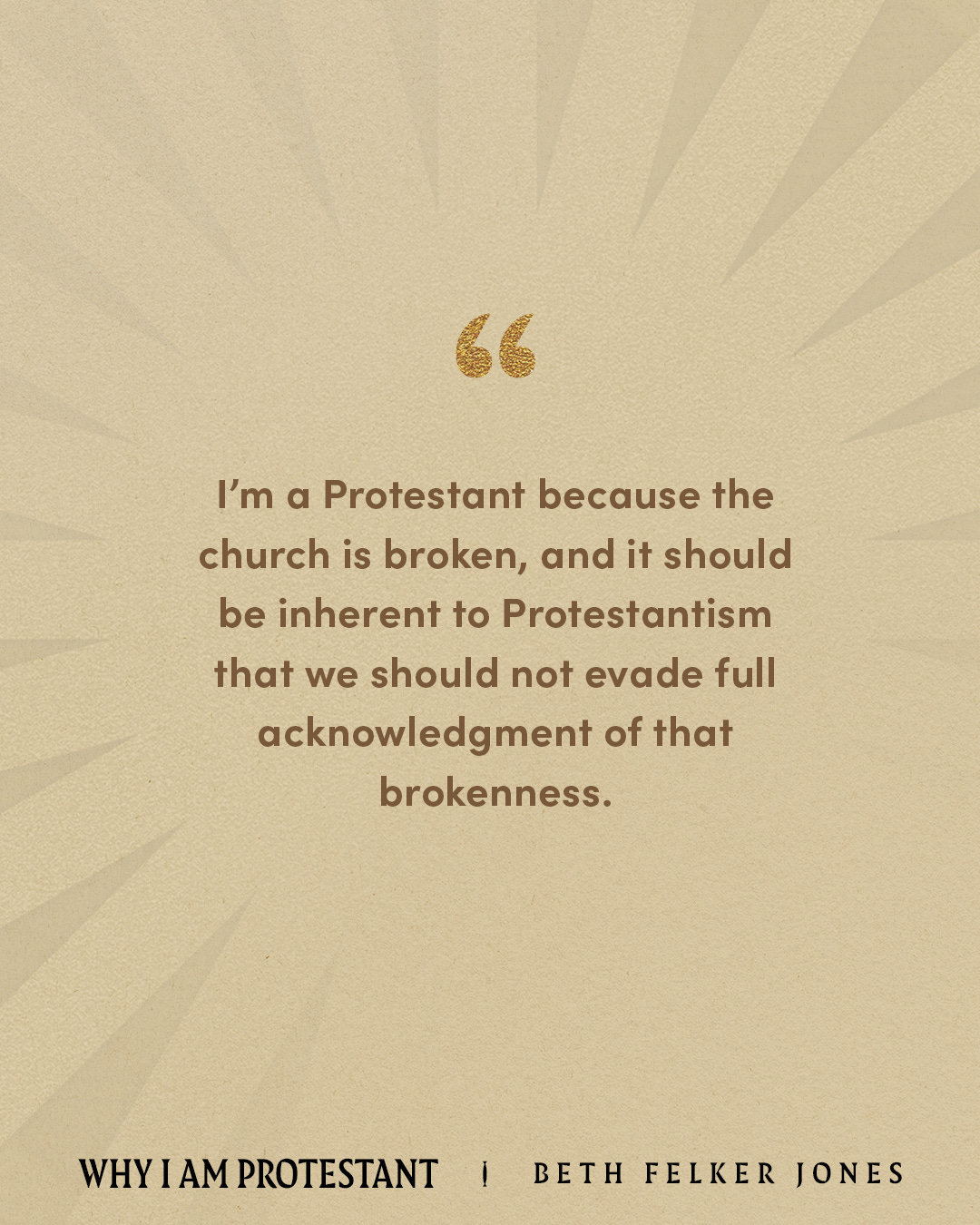
While it is true that the church has been the cause of much pain and much suffering in the world, it is equally true that the local church is God’s plan for working out the revelation of Jesus Christ in the world today. For all my woes about the church, I am equally confronted by the God revealed in Jesus Christ. I am confronted by the God who comes to us and speaks to us and who establishes the Church on earth, not as an institution, but as a witness to this remarkable revelation. The church is a community of witness to King Jesus first and foremost, to a King-dom that is not of this world, but one that has broken into it by the God enfleshed in human skin, and carried forth in power by the Spirit who lives and animates that community of witnesses.
In chapter three, Jones writes,
Protestant ecclesiology is the necessary flowering of Augustine’s ecclesiology of grace. If God can and does work in corrupot places, who are we to limit the church to our own institutions and borders? If every historical church is riddled with sin, who are we to claim the rightness of our own churches? But if church is grace, then Protestant churches are church. More, they are church with the very important mission of promulgating the good news that church is powered by God and not by us. The church is the church by grace and not by institutional structures.
If you are a theology nerd, I do not doubt that you will love the way Beth Felker Jones weaves an account of Protestant ecclesiology in chapter three. She focuses on the unique claims that Protestants make about the revelation of God and then connects those ideas, quite unexpectedly, to Augustine and the early Donatist controversy to spin an ecclesiology of grace amidst brokenness, a theology of church that is both realistic and contextual, non-institutional and non-hierarchical. It is an account of the church that is fundamentally rooted in the grace of God, and quite honestly, I don’t like it because it forces me to accept the scandalous fact that God might be at work somewhere I was certain He wasn’t. But I’m afraid she is right, and I think that Protestantism has labored this theology of the church into being, and that it is a theology we need now more than ever when we are constantly confronted with the blatant brokenness of the church in the world, but especially in the West.
If you look out into the world of Christianity and see nothing but brokenness, perhaps there might be room for you in the Protestant tradition of Christianity, for it is a tradition that fronts God’s grace before anything else, and not only makes space for God’s grace to work in dark places, but insists that God has always worked that way and will continue to do so.
Grace scandalizes our notions of how God is at work in the world today.
3. It Continually Points Me Back to the Word of God
Anyone familiar with the Protestant Reformation ought to be familiar with the five solas: Sola Scriptura (Scripture alone), Sola Fide (Faith alone), Sola Gratia (Grace alone), Solus Christus (Christ alone), and Soli Deo Gloria (To God alone be the glory).
The 16th-century Protestant Reformers were insistent that God must come to us from outside ourselves. This claim rests on the assumption that because humans are flawed and marred by sin, we cannot come to know God through our own reason or intellect or any tradition presented to us. Natural revelation is not enough. That is why the reformers insisted on the primacy of special revelation, and that special revelation comes to us through the Word of God revealed in scripture. That is, no institution, no tradition, and no ritual could effectively mediate the revelation of Godself to us.
This led them to the doctrine of sola scriptura. They claimed that apart from the primacy of scripture, we were incapable of coming to know God fully. Scripture contained the fullest of God’s revelation to us in the sense that it was the primary medium. The Word of God became, for the reformers, the “norming norm” upon which everything else was based.
The reformers did not view scripture in terms of a mere biblicism, worshipping of a book, and denying the need for reason, tradition, or experience. But they placed scripture as the primary means of knowing God above all else.
Beth writes,
We know God because God acts to make Godself known. Scripture is not the only way God does this. Jesus is the decisive revelation of God in history. Scripture is not God, nor does it have the same status Jesus does, but between the first and second comings of Christ, knowing scripture in the power of the Spirit is our primary mode of revelation about him, and it is to him, together with the Father and the Spirit that scripture testifies.
In some circles I run in, I have found that people have a lot of hang-ups with the bible. Sometimes scripture has been wielded more as a weapon than as a healing balm. People have used scripture to justify hate, twisting it’s words for their own selfish purposes. Scripture is at times confusing, alarming, seemingly anti-science, and doesn’t always seem to live up to our experience of reality and the world we inhabit. For some, it is archaic and outdated.
While I understand these qualms about scripture, I also recognize that without scripture, I would not have come to know Jesus. The one who is God’s decisive Word to us. The one who came to us and “tabernacled” among us as the gospel of John writes. It is because of Jesus that we must continually return to scripture, and it is through the lens of Jesus that we must ultimately interpret all of scripture. For those who struggle with the bible, check out this article about moving from a “hermeneutic of suspicion” to a “hermeneutic of trust.”
Oh, and please consider buying this book if you found this topic interesting and want to support a great theologian.
Many thanks for this lovely interaction! It's good to love the shoebox and the mansion!
Just preordered the book. I’m excited to read it.